If you are posting on social media without analyzing the results, you are essentially navigating with your eyes closed. In 2026, where algorithms change weekly and audience attention spans are measured in milliseconds, social media analysis is the only way to separate strategy from guesswork.
But here’s the problem: most guides on “social media analytics” stop at telling you what metrics to track. They never tell you how to think about them, why certain signals matter more than others, or how to turn raw numbers into decisions that actually move the needle.
This 2,800-word guide fixes that. It gives you a complete, repeatable framework for analyzing your social media performance—from raw data to competitive intelligence—using the tools and signals that matter in 2026.
1. What Is Social Media Analysis (And Why 2026 Is Different)
Social media analysis is the systematic process of collecting data from your social channels, measuring it against your goals, and interpreting it to make smarter decisions about content, targeting, and spending.
Why 2026 is a Turning Point:
- Algorithms reward “Durable Attention”: Platforms like TikTok, Instagram, and YouTube now prioritize completion rate, saves, and shares over simple likes. Your analysis must reflect this.
- Social is now Search: Over 40% of Gen Z use TikTok and Instagram as their primary search engines. Analyzing social SEO performance (how your content ranks in social search) is now a core requirement.
- Discovery > Following: More than 50% of your potential reach comes from Discovery Feeds—people who don’t follow you. Analyzing how and why non-followers find your content is critical.
- AI-Powered Insights: Native platform AI (like TikTok Symphony and Instagram’s Content Advice) now provides automated analysis. The question is no longer “Can I get data?” but “Can I interpret it better than my competitors?”
2. The 3-Layer Metrics Framework (+ The Competitive Layer)
Stop tracking 50 metrics. In 2026, every metric you track should fall into one of three layers. The best teams add a 4th: Competitive Context.
Layer 1: Awareness (Are People Seeing You?)
| Metric | What It Tells You | 2026 Benchmark |
|---|---|---|
| Impressions | Total times content was displayed | Varies by platform |
| Reach | Unique users who saw content | Track weekly trend |
| Follower Growth Rate | Velocity of audience building | 1-3% monthly is healthy |
| Share of Voice | Your visibility vs. competitors | Aim for category parity |
Layer 2: Engagement (Do People Care?)
| Metric | What It Tells You | 2026 Benchmark |
|---|---|---|
| Engagement Rate | Interactions relative to reach | 3-6% across platforms |
| Saves | Content perceived as valuable | The #1 “quality” signal |
| Shares | Content worth attaching your name to | TikTok shares up 45% YoY |
| Comments | Depth of audience investment | Quality over quantity |
| Video Completion Rate | Hook strength + content quality | >60% is strong |
| Dwell Time | How long users linger on your post | Rising in importance |
Layer 3: Conversion (Is It Driving Business?)
| Metric | What It Tells You | 2026 Benchmark |
|---|---|---|
| Click-Through Rate (CTR) | Effectiveness of your CTA | 1-3% is standard |
| Referral Traffic | Website visits from social | Track in Google Analytics |
| Conversion Rate | Users completing a desired action | Varies by funnel stage |
| ROAS | Revenue per ad dollar | 4:1 is a strong target |
| Cost Per Lead (CPL) | Efficiency of lead generation | Compare to industry avg |
Layer 4: Competitive Context (How Do You Stack Up?)
This is where most analyses fail. Knowing your engagement rate is 4% is meaningless without knowing if your competitor’s is 2% or 8%.
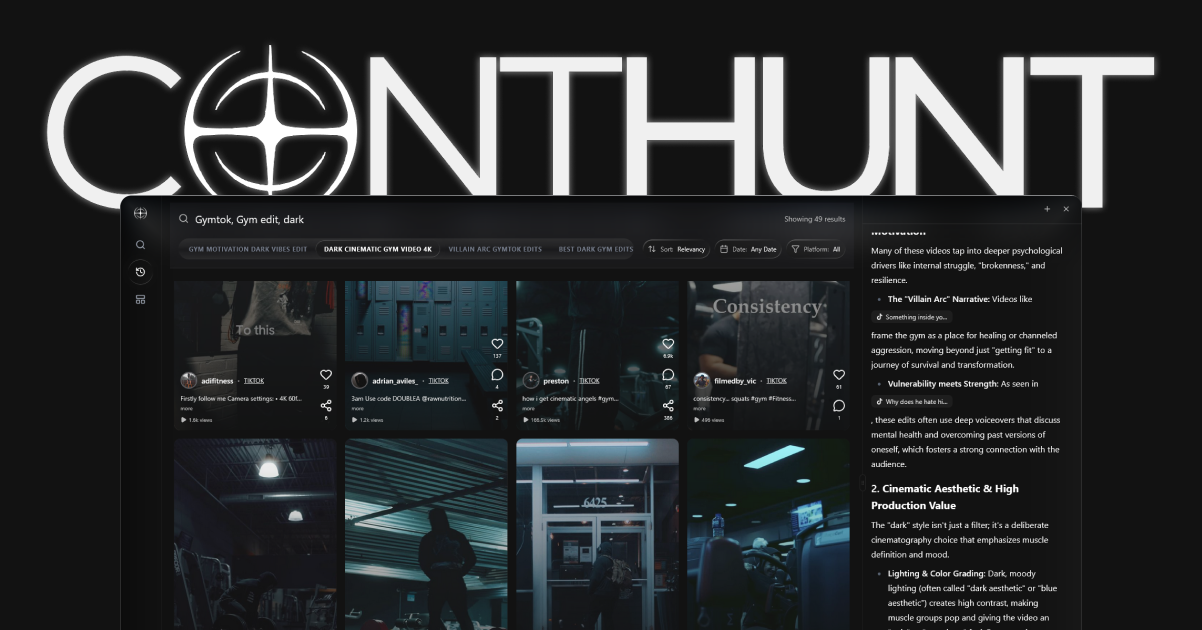
ContHunt provides this layer by:
- Relative Benchmarking: See your metrics compared to the niche average.
- Hook Intelligence: Analyze why competitor content is outperforming—is it the opening line, the format, or the topic?
- Node-Alignment: Discover which “Interest Clusters” are growing in your niche, so your next content lands in the right feed.
Pro Tip: Use the Best Social Media Monitoring Tools (2026) alongside this framework for real-time alerting.
3. Step-by-Step Social Media Analysis Process
Here is the exact 5-step workflow used by high-performing social teams in 2026.
Step 1: Define Your “North Star” Metric
Before touching a dashboard, answer: What is the ONE metric that defines success for this period?
- Brand Awareness Campaign? → Track Reach and Share of Voice.
- Product Launch? → Track CTR and Conversion Rate.
- Community Building? → Track Comments and Saves.
Step 2: Pull Cross-Platform Data
Use native dashboards (Instagram Insights, TikTok Analytics, YouTube Studio) or a unified tool like Sprout Social or Hootsuite to export your data. Key data points:
- Impressions & Reach per post
- Engagement Rate per post
- Top 5 and Bottom 5 posts by engagement
- Referral traffic (from Google Analytics)
Step 3: Identify Patterns (The “Why” Analysis)
Data without interpretation is just noise. For each of your Top 5 posts, answer:
- Format: Was it a Reel, carousel, static image, or text post?
- Topic: What subject matter resonated?
- Timing: When was it posted? Day of week? Time of day?
- Hook: What was the first line or first frame?
For each of your Bottom 5 posts, ask the inverse questions.
Step 4: Run Competitive Benchmarking
Open ContHunt and:
- Compare your top posts’ engagement to your top 3 competitors’ recent posts.
- Identify any “outlier” content from competitors (posts that performed 2x+ their average).
- Analyze the hooks and formats of those outliers.
Step 5: Document Insights & Set Action Items
Distill your analysis into a simple report:
- 3 Key Insights: (e.g., “Carousels outperform Reels for educational topics by 2.1x”)
- 3 Action Items: (e.g., “Create 4 carousel posts about [topic] next month”)
- 1 Experiment: (e.g., “Test posting at 7 PM vs. 12 PM for 2 weeks”)
4. Platform-Specific Analysis Tips (2026)
- Focus Metric: Saves. Instagram’s algorithm in 2026 treats saves as the strongest content quality signal.
- Format Analysis: Reels deliver 35% more engagement than standard video. Carousels still dominate for educational content. Analyze which format wins for your specific niche.
- Stories vs. Feed: Compare Story completion rates to Feed engagement rates. A drop-off after the 3rd Story slide means your pacing is off.
TikTok
- Focus Metric: Shares. With 45% YoY growth in shares, this is TikTok’s strongest signal of “content worth spreading.”
- Follower Gate: In 2026, TikTok shows new content to followers first. If your follower engagement is low, the video won’t reach the broader For You feed. Analyze follower retention as a leading indicator.
- Sound & Hashtag Analysis: Cross-reference your top videos’ sounds and hashtags with trending tags from TikTok Symphony. Were you riding a trend or creating one?
YouTube (Long-Form & Shorts)
- Focus Metric: Average View Duration (AVD). YouTube’s algorithm fundamentally rewards content that holds attention.
- Shorts vs. Long-Form: Analyze them separately. A Short with 100K views that converts 0 subscribers is less valuable than a long-form video with 10K views and 200 new subs.
- Click-Through Rate (CTR): YouTube provides thumbnail-level CTR. If CTR is high but AVD is low, your titles/thumbnails are overpromising.
- Focus Metric: Dwell Time. LinkedIn’s 2026 algorithm heavily weights how long users spend reading your post.
- Text Post Resurgence: Long-form text posts (with line breaks and storytelling) are outperforming video on LinkedIn for B2B audiences.
- Employee Advocacy: If you’re a brand, compare the performance of branded page posts vs. employee personal posts. Employee content typically gets 3-5x the reach.
5. Free vs. Paid Tools Comparison (2026)
| Tool | Type | Best For | Cost |
|---|---|---|---|
| Native Dashboards | Free | Platform-specific data | $0 |
| Google Analytics | Free | Referral traffic & conversions | $0 |
| Buffer | Freemium | Basic scheduling + analytics | $0 - $6/mo |
| Metricool | Freemium | Short-form video analytics | $0 - $18/mo |
| ContHunt | Freemium | Competitive analysis | $0 - $49/mo |
| Sprout Social | Paid | Enterprise reporting | $199+/mo |
| Hootsuite | Paid | Multi-account management | $99+/mo |
Recommendation: Start with Native Dashboards + Google Analytics (free). Add ContHunt for competitive context. Only invest in enterprise tools when managing 5+ accounts or needing automated client reporting.
6. How to Create a Social Media Analysis Report
A great report is not a data dump. It is a decision document. Here is a simple template:
Report Template (Monthly):
- Executive Summary (2-3 sentences): “This month, our Instagram reach grew 12% while engagement rate declined 0.5%. TikTok shares increased 30%, driven by 2 outlier posts. Our primary competitor launched a new content series that is outperforming us in the [topic] node.”
- North Star Metric: [Current value] vs. [Last month] vs. [Target]
- Top 3 Performing Posts: [With format, topic, and key metric for each]
- Bottom 3 Performing Posts: [With hypothesis for underperformance]
- Competitive Snapshot: [From ContHunt: how you compare to top 3 rivals]
- 3 Key Insights: [Patterns discovered]
- 3 Action Items for Next Month: [Specific, measurable changes]
7. Common Analysis Mistakes to Avoid
Mistake 1: Obsessing Over Follower Count
Followers are a vanity metric. An account with 5K engaged followers will outperform one with 50K ghost followers. Track Engagement Rate instead.
Mistake 2: Analyzing in a Vacuum
Your metrics mean nothing without context. A 3% engagement rate is excellent in Finance but below average in Food. Always benchmark against your niche.
Mistake 3: Ignoring “Dark Social”
A significant portion of sharing happens via DMs, private groups, and copy-pasting links—none of which show up in native analytics. Track UTM-tagged links to capture dark social traffic.
Mistake 4: Reporting Without Recommendations
A report that says “engagement went up 10%” is useless without saying why and what to do about it. Every insight must have an action item.
Mistake 5: Analyzing All Platforms Identically
Each platform has a different algorithm and audience behavior. A “like” on LinkedIn has a different weight than a “like” on TikTok. Use platform-specific analysis frameworks.
2026 Social Media Analysis Checklist
- [ ] Have I defined my North Star metric for this period?
- [ ] Have I pulled data from all active platforms?
- [ ] Have I identified my Top 5 and Bottom 5 posts?
- [ ] Have I analyzed the “why” behind each (format, topic, timing, hook)?
- [ ] Have I run competitive benchmarking with ContHunt?
- [ ] Have I documented 3 insights and 3 action items?
- [ ] Have I set 1 experiment for the next period?
Conclusion
Social media analysis in 2026 is not about having more data—it’s about having better interpretation. The brands and creators who win are the ones who pair their own performance data with competitive intelligence from tools like ContHunt, turning raw numbers into strategic advantages.
Stop guessing. Start analyzing. And start benchmarking against the people you’re trying to beat.
Recommended Next Steps:
- Best Social Media Monitoring & Tracking Tools (2026)
- TikTok Hashtags to Go Viral: The Complete Strategy Guide
- 15 Best Competitor Analysis Tools for 2026
Key data
- Global Ad Spend
- $219 Billion — Projected global social media advertising expenditure in 2026, underscoring the commercial importance of performance analysis.
- Reels Engagement Lift
- 35% — Instagram Reels deliver 35% more engagement than standard video posts in 2026, highlighting the need for format-specific analysis.
- TikTok Shares Growth
- +45% YoY — TikTok saw a 45% year-over-year growth in shares per post, making shares the most important engagement signal on the platform.
- Discovery Feed Reach
- >50% — More than half of potential content reach in 2026 comes from discovery feeds (non-followers), making reach analysis critical.
Sources
- Sprout Social Index 2026 · Sprout Social
- Hootsuite Social Trends 2026 · Hootsuite