What is Content Intelligence: The Complete Guide to AI-Powered Content Strategy
What is Content Intelligence? The Short Answer
Content intelligence is the use of AI and data analytics to transform raw content data into actionable insights that drive strategy, improve performance, and maximize ROI.
Think of it as the difference between looking at a spreadsheet of numbers and having an expert analyst explain exactly what those numbers mean and what you should do about it.
Content intelligence answers questions like:
- Which content formats are actually working in your niche right now?
- What topics will trend before they saturate?
- Why does some content go viral while similar posts flop?
- What should you create next to maximize your chances of success?
This guide breaks down exactly what content intelligence is, how it works, and why it’s becoming essential for brands, creators, and marketers in 2026.
The Evolution: From Analytics to Intelligence
Content intelligence didn’t appear overnight. It’s the natural evolution of content marketing technology:
| Stage | Technology | What It Provided | Key Limitation |
|---|---|---|---|
| Web Analytics (2000s) | Google Analytics | Page views, traffic sources | No content-specific insights |
| Social Analytics (2010s) | Platform native tools | Likes, shares, comments | Reactive, not predictive |
| Content Marketing Platforms (2015s) | SEMrush, BuzzSumo | Keyword research, content discovery | Manual analysis required |
| Content Intelligence (2020s) | AI-powered platforms | Predictive insights, automated analysis | Emerging technology |
Traditional analytics tell you what happened. Content intelligence tells you why it happened and what will happen next.
How Content Intelligence Actually Works
Content intelligence platforms combine multiple data sources with AI analysis to extract actionable insights:
Core Data Sources
1. First-Party Data
- Your content performance across platforms
- Audience engagement patterns
- Historical content library analysis
2. Competitive Intelligence
- Competitor content performance
- Market gap identification
- Benchmarking against industry standards
3. Platform-Wide Signals
- Trending topics across TikTok, Reels, Shorts
- Emerging formats and viral patterns
- Algorithm behavior tracking
4. External Context
- Search trend data
- Social conversation volume
- Cultural event correlation
The AI Intelligence Layer
Raw data is useless without interpretation. Content intelligence platforms apply AI in several ways:
| AI Capability | Function | Business Value |
|---|---|---|
| Pattern Recognition | Identifies recurring success factors across thousands of content pieces | Replicate what works |
| Natural Language Processing | Analyzes captions, hashtags, and topics at scale | Understand content themes |
| Predictive Modeling | Forecasts which content will perform based on historical patterns | Make data-backed decisions |
| Anomaly Detection | Spots unusual performance (viral potential or problem areas) | Catch opportunities early |
| Computer Vision | Analyzes visual elements (hooks, pacing, production quality) | Optimize content format |
The 5 Pillars of Content Intelligence
Content intelligence isn’t one thing—it’s a combination of capabilities that work together:
1. Performance Analysis
Understanding which content works and why is the foundation.
What it provides:
- Granular metrics beyond likes and views (retention curves, share velocity, engagement quality)
- Cross-platform performance comparison
- Content scoring based on multiple success factors
Why it matters: You stop guessing what works and start replicating proven success patterns.
2. Trend Prediction
The most valuable capability of content intelligence is spotting trends before they saturate.
How it works:
- Monitors velocity (how fast content is growing) across platforms
- Identifies emerging formats and topics in early stages
- Predicts which trends have staying power vs. flash-in-the-pan
Why it matters: Early adoption of trends gives you exponential reach advantages. Getting in when competition is low means easier virality.
Example: A content intelligence platform might detect that “behind-the-scenes manufacturing videos” are growing at 3x normal velocity on TikTok but haven’t yet spread to Reels or Shorts. Creators who act on this insight can establish ownership before the format saturates.
3. Competitive Intelligence
Knowing what works for your competitors is faster than discovering it yourself.
What you can learn:
- Which content formats perform best in your niche
- What posting schedules and frequencies top competitors use
- Which topics and angles are underserved (opportunity gaps)
- How your performance compares to industry benchmarks
Why it matters: Competitive intelligence lets you stand on the shoulders of giants rather than reinventing the wheel.
4. Content Scoring
AI analyzes content and assigns scores based on predicted performance.
Scoring factors typically include:
- Hook strength (first 1-2 seconds)
- Retention potential (pacing and structure)
- Shareability (emotional triggers and social currency)
- Timing (trend alignment and competition level)
- Production quality (visual and audio elements)
Why it matters: Content scoring lets you evaluate ideas before production, focusing resources on winners.
5. ROI Measurement
Content intelligence connects creative efforts to business outcomes.
What it tracks:
- Cost-per-view across different content types
- Conversion rates by content format
- Lifetime value of audiences acquired through content
- Brand lift from viral moments
Why it matters: You prove content’s value to stakeholders and optimize budget allocation.
Content Intelligence vs. Traditional Analytics
The distinction matters because it determines whether you’re reactive or proactive:
| Traditional Analytics | Content Intelligence |
|---|---|
| What happened (past) | What will happen (future) |
| Basic metrics (views, likes) | Predictive insights (virality probability) |
| Manual analysis required | Automated pattern detection |
| Single-platform focus | Cross-platform synthesis |
| Reactive reporting | Proactive recommendations |
| Data dumps | Actionable insights |
Example in action:
Traditional analytics approach: “Your last video got 10,000 views. Here’s a chart.”
Content intelligence approach: “Your last video outperformed your average by 300%. Analysis shows it used a curiosity-gap hook in the first second and a list format. Similar videos in your niche have a 67% higher chance of going viral. We recommend creating 3 variations on this topic while the format is emerging.”
Who Needs Content Intelligence?
Content intelligence isn’t just for enterprises. It scales to anyone serious about content performance:
Individual Creators
Challenges: Limited time, need to maximize every piece of content, competing against full-time teams
How content intelligence helps:
- Research viral formats in minutes instead of hours
- Identify which ideas are worth full production effort
- Find low-competition topics with high viral potential
- Understand why specific videos performed well or poorly
ROI impact: One viral video discovered through content intelligence can justify months of investment.
Brands and E-commerce
Challenges: Proving ROI, scaling content production, maintaining quality across channels
How content intelligence helps:
- Connect content performance to sales and conversions
- Identify which product angles resonate with audiences
- Optimize influencer partnerships based on content performance
- Scale what works across markets and regions
ROI impact: Data-driven content strategy can reduce customer acquisition costs by 30-50%.
Marketing Agencies
Challenges: Managing multiple clients, proving value to stakeholders, staying ahead of trends
How content intelligence helps:
- Provide competitive intelligence as a service
- Identify trends clients can leverage
- Create performance benchmarks across industries
- Automate reporting with actionable insights
ROI impact: Agencies using content intelligence report 2-3x better client retention rates.
Media Companies
Challenges: Constant content demand, audience fragmentation, platform algorithm changes
How content intelligence helps:
- Predict which stories will resonate across platforms
- Optimize distribution strategy per platform
- Identify talent based on content performance data
- Monetize content more effectively through audience insights
ROI impact: Media companies using content intelligence see 40% higher engagement rates.
The ROI of Content Intelligence
Investing in content intelligence pays dividends across multiple dimensions:
Time Savings
| Task | Without Intelligence | With Intelligence | Time Saved |
|---|---|---|---|
| Trend Research | 5-10 hours/week | 1-2 hours/week | 75% |
| Competitor Analysis | 3-5 hours/week | 30 minutes/week | 85% |
| Content Ideation | 4-6 hours/week | 2-3 hours/week | 50% |
| Performance Review | 2-3 hours/week | 1 hour/week | 60% |
Total: 14-24 hours saved per week—that’s an entire extra day of creative time.
Performance Improvements
Organizations using content intelligence report:
- 2-3x higher viral hit rate (videos reaching 100K+ views)
- 40-60% better engagement rates on average content
- 50% reduction in content flops (posts that underperform baseline)
- 30% faster audience growth month-over-month
Budget Efficiency
Content intelligence optimizes spend:
- Production focus: Spend budget on content with highest predicted performance
- Platform allocation: Direct resources to platforms with best ROI for your niche
- Influencer selection: Choose partners based on content performance, not just follower count
- Trend timing: Enter trends when cost-to-participate is low
Key Features to Look for in Content Intelligence Platforms
Not all platforms are created equal. Here’s what to evaluate:
Must-Have Features
1. Multi-Platform Coverage
- Aggregates data from TikTok, Instagram Reels, YouTube Shorts, and more
- Cross-platform pattern detection (formats that work across multiple apps)
2. Velocity Metrics
- Tracks how fast content is growing relative to baseline
- Identifies emerging trends before they saturate
3. Deep Content Analysis
- Frame-by-frame analysis of video content
- Caption and hashtag analysis
- Audio/music trend detection
4. Competitive Intelligence
- See competitor performance without following them
- Benchmark against industry standards
- Identify content gaps in your niche
5. Actionable Recommendations
- Not just data, but clear next steps
- Content suggestions based on proven patterns
- Trend alerts with action frameworks
Nice-to-Have Features
- API access for custom integrations
- Team collaboration tools
- Custom reporting and dashboards
- Influencer discovery and vetting
- Content calendar optimization
- ROI measurement and attribution
Common Misconceptions About Content Intelligence
Let’s clear up some confusion:
Myth 1: “Content intelligence replaces creativity”
Reality: Content intelligence enhances creativity. It handles the data work so you can focus on creative execution. Think of it as a GPS system—it tells you the best route, but you still drive the car.
Myth 2: “It’s only for big companies with big budgets”
Reality: Individual creators often benefit most because they’re time-poor and need every piece of content to count. Many platforms offer creator-friendly pricing.
Myth 3: “AI can’t understand creative nuance”
Reality: Modern AI is surprisingly good at pattern recognition, even for creative content. It may not “understand” humor, but it can identify which humorous formats perform best in your niche.
Myth 4: “It’s just more data to overwhelm me”
Reality: Good content intelligence platforms simplify, not complicate. They surface insights, not raw data. Less information, but more relevant.
Myth 5: “It’s cheating to use data for creative decisions”
Reality: Every successful creator uses data—they just might not call it that. Learning what works from observation IS data analysis. Content intelligence just scales that process.
How to Get Started with Content Intelligence
Ready to add intelligence to your content strategy?
Step 1: Define Your Goals
What matters most to you right now?
- Finding viral trends? Look for strong trend prediction features
- Understanding competitors? Prioritize competitive intelligence
- Optimizing your content? Focus on deep content analysis
- Proving ROI? Ensure robust measurement and reporting
Step 2: Audit Your Current Process
Where are you spending the most time with minimal returns?
- Hours spent doom-scrolling for inspiration? Trend intelligence helps
- Inconsistent content performance? Analysis features help
- Unclear which platforms to prioritize? Multi-platform coverage helps
- Difficulty explaining content value to stakeholders? ROI measurement helps
Step 3: Start with a Free Trial
Most platforms offer trials or demos. Use this time to:
- Verify data accuracy for your niche
- Test how actionable the insights are
- Evaluate the learning curve
- Assess if it fits your workflow
Step 4: Implement Gradually
Don’t overhaul everything at once:
- Week 1: Use trend intelligence for 20% of content
- Week 2: Add competitive analysis to your research process
- Week 3: Use content scoring to prioritize your content calendar
- Week 4: Establish a weekly intelligence review routine
How ContHunt Delivers Content Intelligence
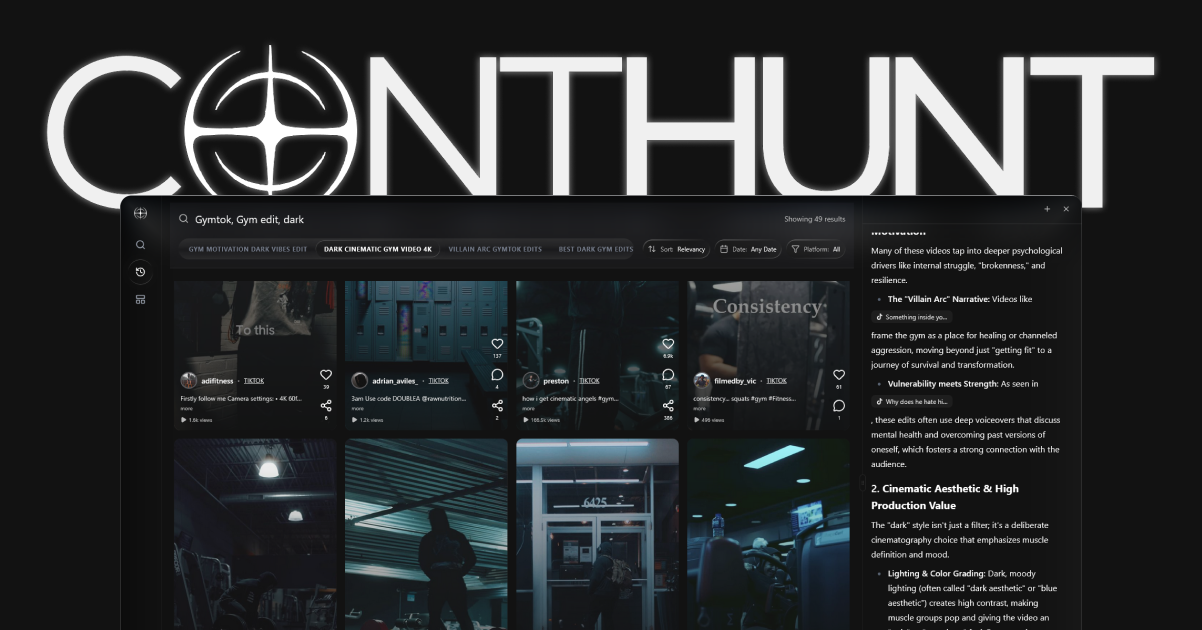
ContHunt is a content intelligence platform built for the multi-platform era.
What makes ContHunt different:
- True Multi-Platform Analysis — See patterns across TikTok, Instagram Reels, and YouTube Shorts in one unified dashboard
- Velocity Metrics — Identify trending content before it’s obvious, giving you a first-mover advantage
- Deep Research Agent — Frame-by-frame AI analysis that extracts hooks, pacing, and structure from viral content
- Niche Hunter — Find low-competition topics with high viral potential in your specific niche
- Pattern Extraction — Turn one winning video into multiple variations with proven mechanics
Who it’s for:
- Individual creators who want every piece of content to count
- Brands who need to prove content ROI
- Agencies who want to offer competitive intelligence to clients
Instead of spending hours researching trends and analyzing competitors, you get a focused feed of actionable insights you can apply immediately.
View Demo to see ContHunt in action.
Bottom Line: What is Content Intelligence?
Content intelligence transforms content marketing from intuition-based to insight-driven.
It answers the questions that keep marketers up at night:
- What should I create next?
- Why did that work (or not work)?
- What are my competitors doing that I’m not?
- Which trends should I jump on?
- How do I prove this is worth the investment?
The brands and creators winning in 2026 aren’t necessarily the most creative or the best resourced. They’re the ones using data to make smarter decisions about where to direct their creative energy.
Content intelligence doesn’t replace creativity—it amplifies it by ensuring your best ideas get the attention they deserve, and your limited resources focus on content with the highest probability of success.
Ready to stop guessing and start engineering content performance? Start with ContHunt and see the difference intelligence makes.