Social Media Competitive Analysis Tools: What to Use (and What to Ignore)

Why competitive analysis matters (and why most teams do it wrong)
“Competitive analysis” isn’t a monthly spreadsheet. It’s a repeatable advantage: you identify what’s already winning in your niche, extract the mechanics, and ship variations faster than everyone else.
Most teams fail because they treat competitor research like a vanity-metric exercise:
- “Competitor A posted 4x this week.”
- “Competitor B got 12k likes.”
- “Competitor C is growing faster.”
Cool. Now what do you publish tomorrow?
Modern short-form distribution is driven by watch behavior signals (e.g., how people engage, whether they finish, whether they share/save), not just follower counts. Instagram’s creator resources and Meta transparency pages explain ranking and prediction systems for content, and TikTok algorithm guides consistently emphasize user interactions and watch behavior signals as major drivers of distribution:
- Instagram creators ranking overview: https://creators.instagram.com/grow/algorithms-and-ranking?locale=en_GB
- Meta transparency “Explaining ranking” + Reels systems: https://transparency.meta.com/features/explaining-ranking/
- TikTok algorithm (practical, updated): https://buffer.com/resources/tiktok-algorithm/
So the goal of competitive analysis is simple:
Find the content patterns that reliably generate watch + shares, then use them to build your own content engine.
That’s exactly where Content Intelligence beats “manual scrolling.”
What to track in competitor content (the 8 metrics that actually move distribution)
You can’t “out-create” competitors if you don’t measure the right signals. Track these:
-
Format type
Examples: POV, talking head, listicle, reaction, before/after, “3 mistakes,” mini-story, demo, UGC testimonial. -
Hook style (first 1–2 seconds)
Examples: contrarian (“Stop doing X”), curiosity gap (“Nobody tells you this…”), shock (“I wasted $500…”), outcome-first (“Here’s the result…”). -
Retention proxy
You usually won’t have their retention chart, so use proxies:- video length vs views
- comment quality (“watched twice”, “this is gold”)
- replay/loop cues (fast lists, hidden details)
-
Share triggers Shares/sends are a strong “this must be shown” signal. Track what makes the viewer forward it:
- identity (“this is so me”)
- utility (saves time/money)
- status (makes them look smart)
- emotion (shock, relatable pain, inspiration)
-
Velocity Not just “high views.” High views fast relative to that creator’s baseline. This is the difference between a saturated trend and a breakout.
-
CTA placement When do they ask for the follow/subscribe? Early? Mid? Last 2 seconds?
-
Creative mechanics
- cut frequency
- captions style
- pattern interrupts
- camera changes
- sound/voice pacing
-
Content clusters Topics they repeat weekly (that keep working). This reveals the niche “money formats.”
If you’re using a social suite, you’ll often get benchmarking for posting frequency, engagement, follower growth, and “top posts” style comparisons (e.g., Hootsuite’s competitive analysis + benchmarking capabilities):
- Competitive analysis overview: https://www.hootsuite.com/platform/competitive-analysis
- How-to guide + template: https://blog.hootsuite.com/competitive-analysis-on-social-media/
That’s useful — but it’s not enough for modern short-form.
The problem with most “competitive analysis tools”
Most tools are built for:
- publishing calendars
- inbox management
- high-level reporting
- brand mentions / social listening
They’re not built for:
- multi-platform short-form aggregation
- reverse-engineering why a video worked
- identifying low-competition topics before saturation
- generating 20 variations off one winning structure
In other words, they can tell you what happened, but not reliably what to create next.
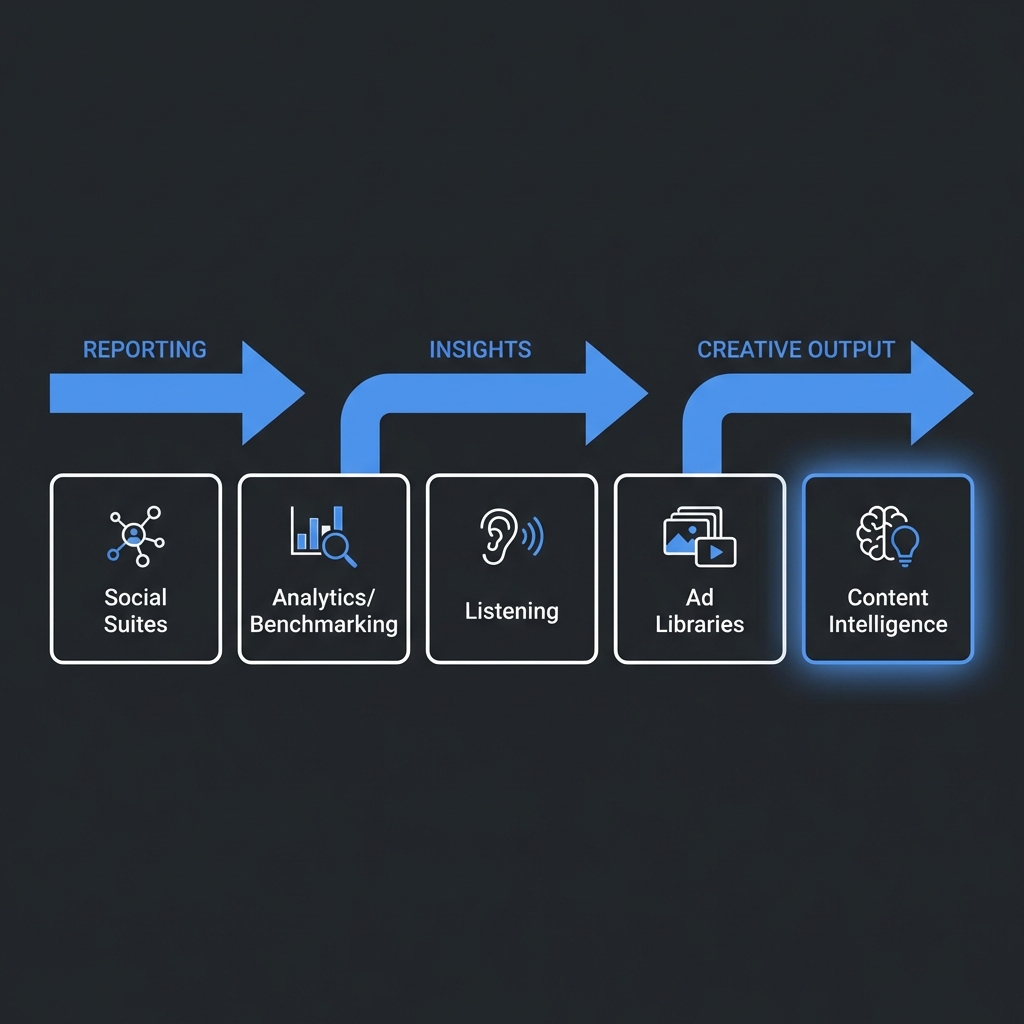
The 5 categories of social media competitive analysis tools
You don’t need “one tool.” You need the right layer for your workflow.
1) Social management suites (good for reporting + team workflow)
These are best when you need:
- publishing, approvals, inbox, reporting
- competitor benchmarking dashboards
- consistent client reporting (agencies)
Examples to evaluate:
- Sprout Social (metrics frameworks + reporting): https://sproutsocial.com/insights/social-media-metrics/
- Hootsuite Competitive Analysis / Benchmarking: https://www.hootsuite.com/platform/competitive-analysis
Use them if: your bottleneck is operations + reporting.
Skip them if: your bottleneck is content ideas + viral mechanics.
2) Social analytics + benchmarking tools (best for fast comparisons)
These tools often help you compare:
- engagement rate, reach, impressions
- engagement by reach (more honest than by follower count)
- best posts, posting times, content mix
A useful metric to track is engagement rate and engagement by reach, because it shows how compelling the content is among people who actually saw it:
- Social media metrics reference: https://blog.hootsuite.com/social-media-metrics/
- Engagement-rate-by-reach discussion: https://www.socialinsider.io/blog/social-media-metrics/
Use them if: you want quick benchmarking and clean performance reporting.
Skip them if: you need deep creative breakdowns.
3) Social listening platforms (best for “what people are saying”)
Listening tools track:
- share of voice
- sentiment, conversations, rising topics/hashtags
This is great for PR, comms, and brand health — but listening ≠ virality mechanics.
- Example overview: https://www.sprinklr.com/blog/social-media-competitor-analysis/
Use them if: your KPI is brand mentions, reputation, PR.
Skip them if: your KPI is short-form performance and creative output.
4) Ad libraries + creative intel (best for paid + UGC ads)
If you run paid campaigns, you want to track:
- competitor offers
- angles
- landing page patterns
- hooks that convert
This helps you build UGC scripts that align with proven outcomes (not vibes).
Use them if: you run ads and need ad creative intelligence.
Skip them if: you’re organic-only and primarily short-form growth.
5) Content Intelligence (best for “what people are watching — and why”)
This is the missing layer.
Content Intelligence is built for:
- multi-platform content aggregation (TikTok + Reels + Shorts)
- identifying winners using velocity/virality signals
- deep analysis of hooks, pacing, visuals, structure
- turning one winner into 10–20 variations
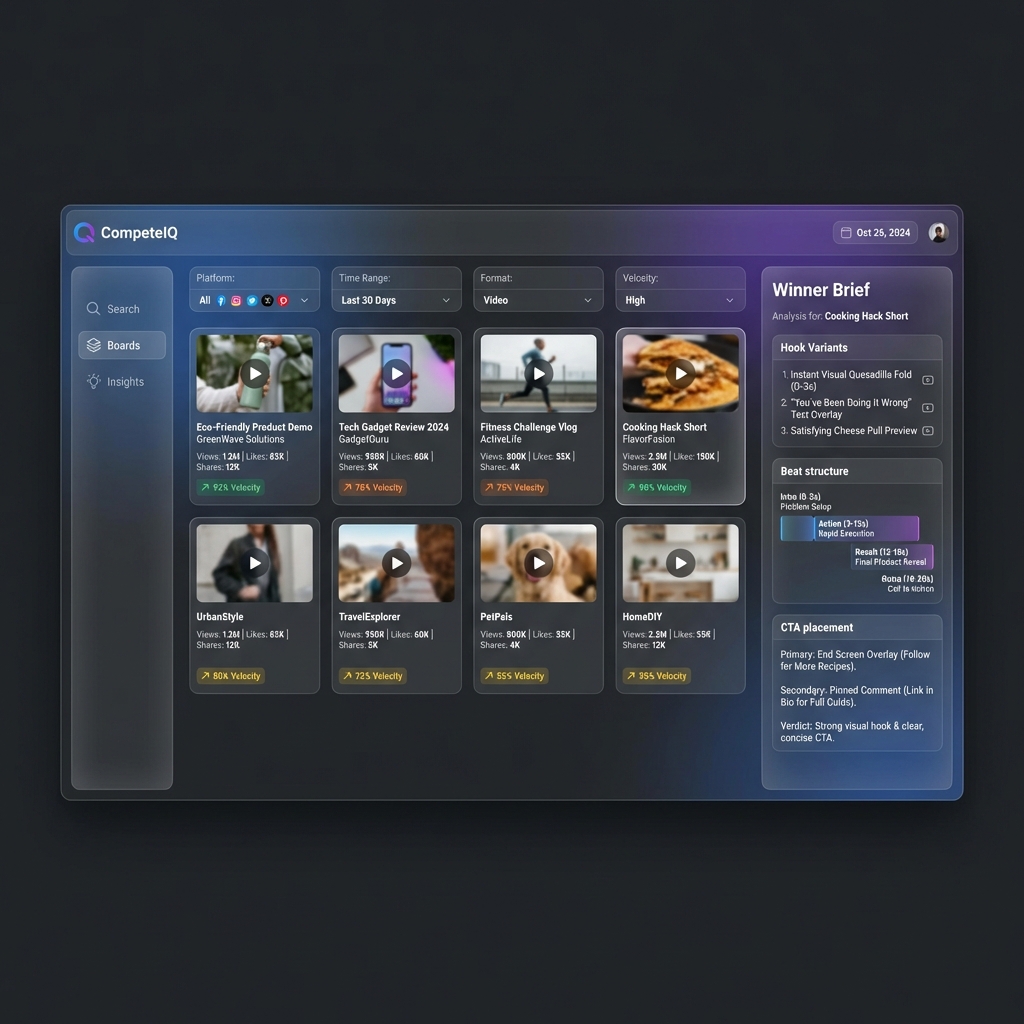
This is exactly what Conthunt is designed to do:
- Workflow: https://conthunt.app/#workflow
- Demo: https://conthunt.app/#simulated-app-frame
- Start using ContHunt →
If your team is drowning in manual scrolling and competitor noise, Content Intelligence collapses the time-to-insight.
The tool stack cheat sheet (pick based on your bottleneck)
Here’s the fastest decision framework:
- Need reporting + approvals + inbox? → Social management suite
- Need quick competitor benchmarks + charts? → Analytics/benchmarking tool
- Need brand mentions + sentiment + share of voice? → Social listening
- Need UGC ads + offers + paid angles? → Ad libraries/creative intel
- Need what-to-post-next + why-it-works + multi-platform winners? → Content Intelligence (Conthunt)
A practical 7-step workflow to beat competitors (weekly, repeatable)
This is the workflow we recommend to teams that want more output without lower quality.
Step 1: Choose 5 competitors (and 3 “adjacent winners”)
Don’t only track direct competitors. Track adjacent niches with better creative:
- adjacent niches often pioneer formats first
- your niche adopts them later
Step 2: Pull the top 20 posts (not the last 20)
Recency is helpful, but you want “winners,” not “recent.”
Step 3: Classify posts by format + hook
Create a simple table:
- Format type
- Hook type
- Topic cluster
- CTA style
This becomes your “format library.”
Step 4: Identify the 3 repeatable structures
Look for the patterns they repeat:
- “3 mistakes” + fast cuts + bold captions
- “before/after” + proof + CTA late
- “myth-busting” + contrarian hook + punchy payoff
Step 5: Extract a “winner brief” (the mechanics, not the topic)
A winner brief should include:
- Hook variants (3)
- Beat-by-beat structure (5–7 beats)
- Visual pacing rules
- Caption style
- CTA placement
Step 6: Generate 10 variations (angle swaps)
Same structure, different angles:
- beginner vs advanced
- budget vs premium
- “do this” vs “stop doing this”
- creator vs brand perspective
- “mistakes” vs “checklist”
Step 7: Publish + measure + iterate
Your goal is not one viral hit. Your goal is an engine that improves weekly.
This is where Conthunt compresses the process: it’s built to replace manual digging with fast multi-platform scanning + deep breakdowns + pattern extraction:
- See Pricing: https://conthunt.app/#pricing
When Conthunt is the right answer (and when it isn’t)
Conthunt is the right answer when:
- your team spends hours “researching” and still feels uncertain
- you need multi-platform aggregation (not single-platform guessing)
- you want velocity-based discovery (spot winners before saturation)
- you want deep analysis of hooks/structure to produce variations
Conthunt is not the right answer when:
- you only need scheduling + inbox management
- you don’t publish short-form video content
- you have no intention of building a structured content workflow
But if you’re serious about short-form performance, competitive analysis is no longer optional — it’s how modern teams compound.
Next step
If you want to run this workflow in minutes (instead of burning half a day scrolling), start here:
- View Demo: https://conthunt.app/#simulated-app-frame
- Workflow: https://conthunt.app/#workflow
- Get Started →